

What aquaponics means
Aquaponics combines two farming methods in a single system: recirculating aquaculture (raising fish in tanks) and hydroponics (growing plants without soil). Water flows from the fish tanks, through filters and plant beds, and back to the fish.[1]
The UN Food and Agriculture Organization (FAO) describes it as managing a small ecosystem built from three groups of living things: fish, plants and bacteria.[1]
How the cycle works
- FishFish eat their feed and release waste into the water, including ammonia, which is toxic to fish if it builds up.[1]
- BacteriaHelpful bacteria in the filter convert ammonia into nitrite and then into nitrate. This natural process is called nitrification.[3]
- PlantsPlants absorb the nitrate and other nutrients through their roots and use them to grow.[1]
- Clean waterThe cleaned water flows back to the fish tanks, and the cycle starts again.[1]
Ammonia-oxidising bacteria such as Nitrosomonas carry out the first step, and nitrite-oxidising bacteria such as Nitrobacter carry out the second.[3] The bacteria need time to settle in, so a new system usually cycles for about four weeks before anything is planted.[3]
Keeping three living groups happy
Fish, plants and bacteria each prefer slightly different water conditions, so an aquaponic system runs on a careful compromise.
| What is managed | Typical guidance | Why |
|---|---|---|
| Water pH | Kept close to 7.0[2]; 6.5 to 7.5 is a common working range[3] | Nitrifying bacteria work best at 7.0 to 9.0, while many hydroponic plants prefer about 5.8 to 6.2. Neutral water suits both well enough.[2] |
| Water temperature | About 18 to 30 °C (64 to 86 °F) suits most fish and plants[3] | Sudden temperature swings can harm fish, plants and the bacteria.[4] |
| Fish feed vs. plant area | 60 to 100 g of fish feed per m² of plant area per day in raft systems[2] | This balances the nutrients the fish produce with what the plants can take up.[2] |
Common aquaponic setups
The FAO manual describes three main designs:[1]
- Media beds: plants grow in containers filled with gravel or clay pebbles, which also hold the bacteria.
- Nutrient film technique (NFT): a thin stream of water runs through narrow channels past the plant roots.
- Deep water culture (rafts): plants sit in floating rafts with their roots hanging in the water. This design suits leafy greens and other vegetables.[2]
Which fish and plants are used?
Tilapia is the fish most commonly raised in aquaponic systems.[2] Other species include carp, catfish and trout, depending on the climate.[1]
Culinary herbs such as basil, mint, parsley, coriander and chives are among the best-suited crops, and fast-growing leafy greens such as lettuce also do well.[2]
Why aquaponics matters in the UAE
Water is a major constraint on farming in the UAE. In the Middle East and North Africa, agriculture can account for up to 90% of water use.[4] The FAO also notes that freshwater availability in the Near East and North Africa has fallen by two-thirds over the past 40 years, and that the UAE imports about 90% of its food.[5]
Because aquaponics recirculates its water, it needs far less than field farming. One scientific review estimates that aquaponics uses less than 10% of the water of conventional agriculture, depending on the climate.[4] The FAO lists aquaponics and recirculating aquaculture among the innovations that let arid countries recycle and reuse water.[5]
The FAO notes that aquaponics is complex and needs a substantial start-up investment.[1] Heating or cooling the water can be costly, and nutrient levels must be monitored.[4] Researchers also point out that more data is still needed on the economics of commercial systems.[4] Good management is what makes the system work.
See aquaponics in action in Al Ain
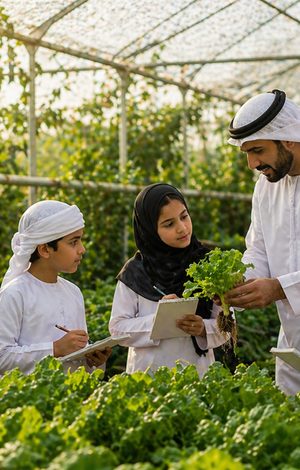
Al Ain Aquaponic Farm was founded in 2017. Fish are raised in our aquaponic system, as part of a farm that also includes organic growing, livestock, poultry and honey production. On a visit you can feed the fish, join a guided tour of how the system works, and see how fish, plants and water connect.
Frequently asked questions
Is aquaponics the same as hydroponics?
No. Hydroponics grows plants in water with added nutrient solutions. Aquaponics adds fish to the system, and their waste, converted by bacteria, provides the plants' main nutrients.[1]
Does aquaponics use soil?
No. Plants grow in water or in an inert material such as gravel or clay pebbles, with their roots taking nutrients from the circulating water.[1]
How long does a new system take to start?
Usually about four weeks. The bacteria must establish before plants are added, and the Oklahoma State University guide recommends allowing at least four weeks.[3]
Which fish is most common in aquaponics?
Tilapia is the species most commonly raised in aquaponic systems.[2]
Sources
- Somerville, C., Cohen, M., Pantanella, E., Stankus, A. & Lovatelli, A. (2014). Small-scale aquaponic food production: Integrated fish and plant farming. FAO Fisheries and Aquaculture Technical Paper No. 589. Rome: FAO.
- Rakocy, J.E., Masser, M.P. & Losordo, T.M. Recirculating Aquaculture Tank Production Systems: Aquaponics — Integrating Fish and Plant Culture. Southern Regional Aquaculture Center, Publication No. 454 (revised edition). Accessed October 2026.
- Oklahoma State University Extension. Nitrification and Maintenance in Media Bed Aquaponics. Fact sheet, accessed October 2026.
- Goddek, S., Delaide, B., Mankasingh, U., Ragnarsdottir, K.V., Jijakli, H. & Thorarinsdottir, R. (2015). Challenges of Sustainable and Commercial Aquaponics. Sustainability, 7(4), 4199–4224. doi:10.3390/su7044199.
- Food and Agriculture Organization of the United Nations (2021). Fishing for change in the Emirati desert. United Nations in the UAE, 2 February 2021.